

Back in March 2025, I summarized the twelve CHIPs submitted in the prior six months. The pace has not let up. Fifteen more proposals have landed on the CHIPs repository since then, so here’s a catch-up focused on what each one could enable.
CHIP-0047 – NFC Offer Data
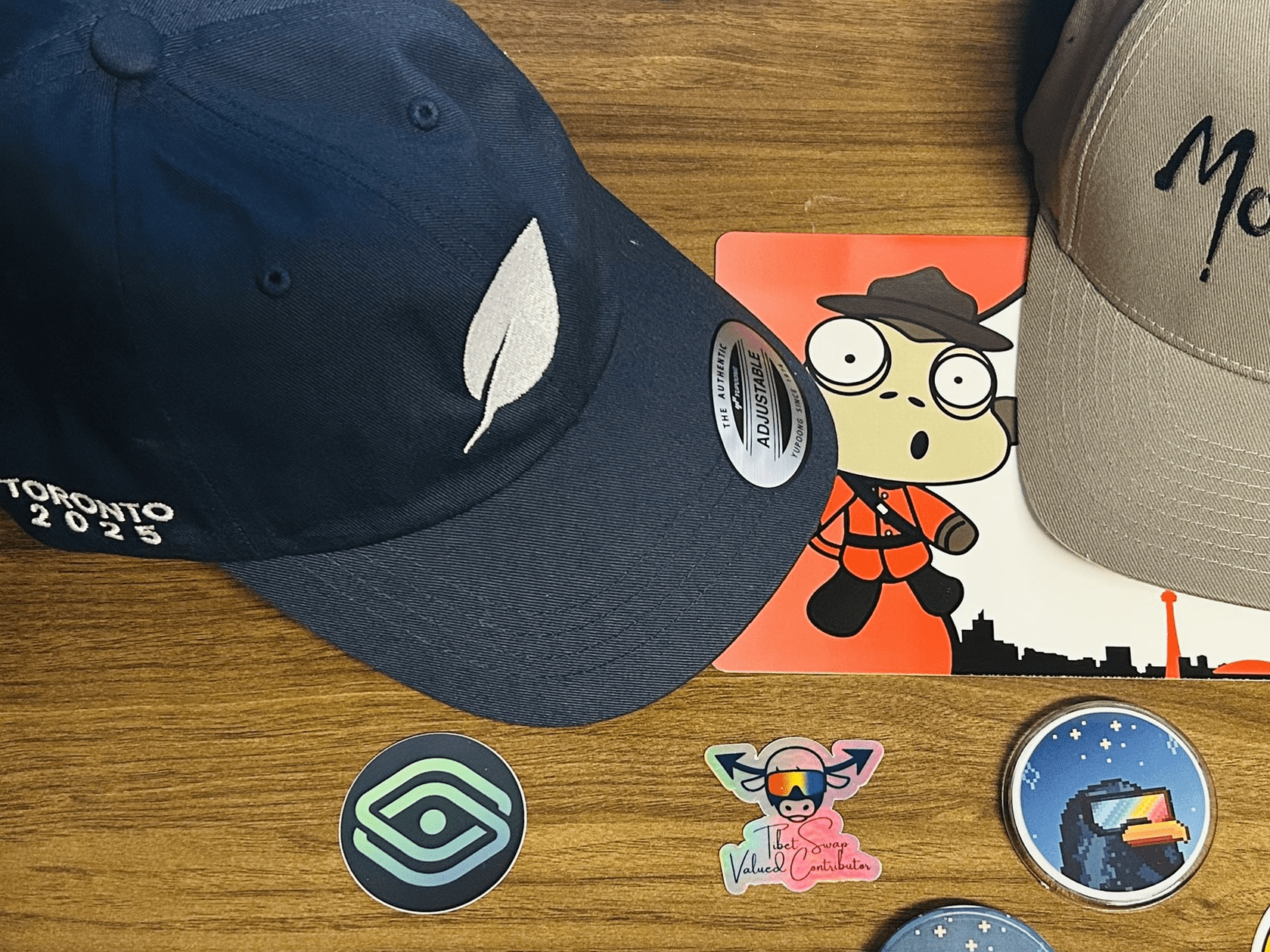
Enables: physical items linked to NFTs. Trading cards, art certificates, luxury goods, POAPs, such as the cap given out at Chia Toronto 2025 last year.
This one standardizes how NFT offers get stored on NFC tags, the same tap-to-read chips in contactless cards. Tap a physical card with your phone and claim or verify the NFT behind it. It builds on the secured offers from CHIP-0042 and is already Final.
CHIP-0048 & CHIP-0049 – New Proof of Space and 3.0 Fork Info
Enables: A more secure and accessible plot format and establishes the hard fork timeline.
The biggest change in Chia’s history, and covered in depth in Proof of Space 2.0 – Latest updates and The Plot Reset of 2026, so I’ll keep it short here. The hard fork is now targeting block 9,562,000, around November 2026, with old plots phasing out over the following 256 days.
CHIP-0050 & CHIP-0051 – Action Layer + Reward Distributor
Enables: a framework for building dApps on Chia, and staking rewards as its first application.
Historically, building a dApp in Chialisp has meant reinventing a lot of plumbing every time. Yakuhito’s Action Layer (CHIP-0050) handles the common needs (state, reserves, many users interacting at once) so developers can focus on what their app actually does. The Reward Distributor (CHIP-0051, with Michael Taylor) is the first app built on it: stake NFTs or CATs, or host DataLayer mirrors for the DIG Network, and rewards accumulate on-chain until you claim them all in one transaction.
CHIP-0052 – Partial Offers
Enables: limit orders and a granular orderbook on Chia DEXes.
Regular offers are all-or-nothing. If someone offers 1000 XCH for 2 SBX, you can’t take half. Partial Offers let a maker post one big offer that many takers fill in pieces. This is the missing piece for a traditional orderbook experience on dexie, and it’s already Final.
CHIP-0053 – Secure the Bag for Distributed Payouts
Enables: paying a million people by committing a single coin.
Instead of a million individual payments, payments get bundled into a tree of coins. The sender creates just the top coin, then anyone can unwind the tree at their leisure, ideally when fees are low. This is how Permuto Capital plans to pay dividends to Dividend Certificate holders (see Trusting the Curve), but the same trick works for something like airdropping to every holder of an NFT collection or paying royalties to past Pot Potato holders. The idea was originally proposed for Bitcoin back in 2019 and never implemented there but Chia went ahead and built it.
CHIP-0054 & CHIP-0055 – XCHandles and CATalog
Enables: human-readable names and a shared token database, both fully on-chain.
Two more from Yakuhito, built on the Action Layer. XCHandles lets you send to a handle like @yak instead of a long address, with ownership as an NFT and uniqueness enforced on-chain. As Yakuhito put it, XCHandles only goes down when Chia goes down. CATalog fixes the mess of every wallet keeping its own token list: issuers register their CAT’s name and image once, on-chain, and everyone reads from the same database.
As of writing, XCHandles is on track to launch, see the summary article to learn more.
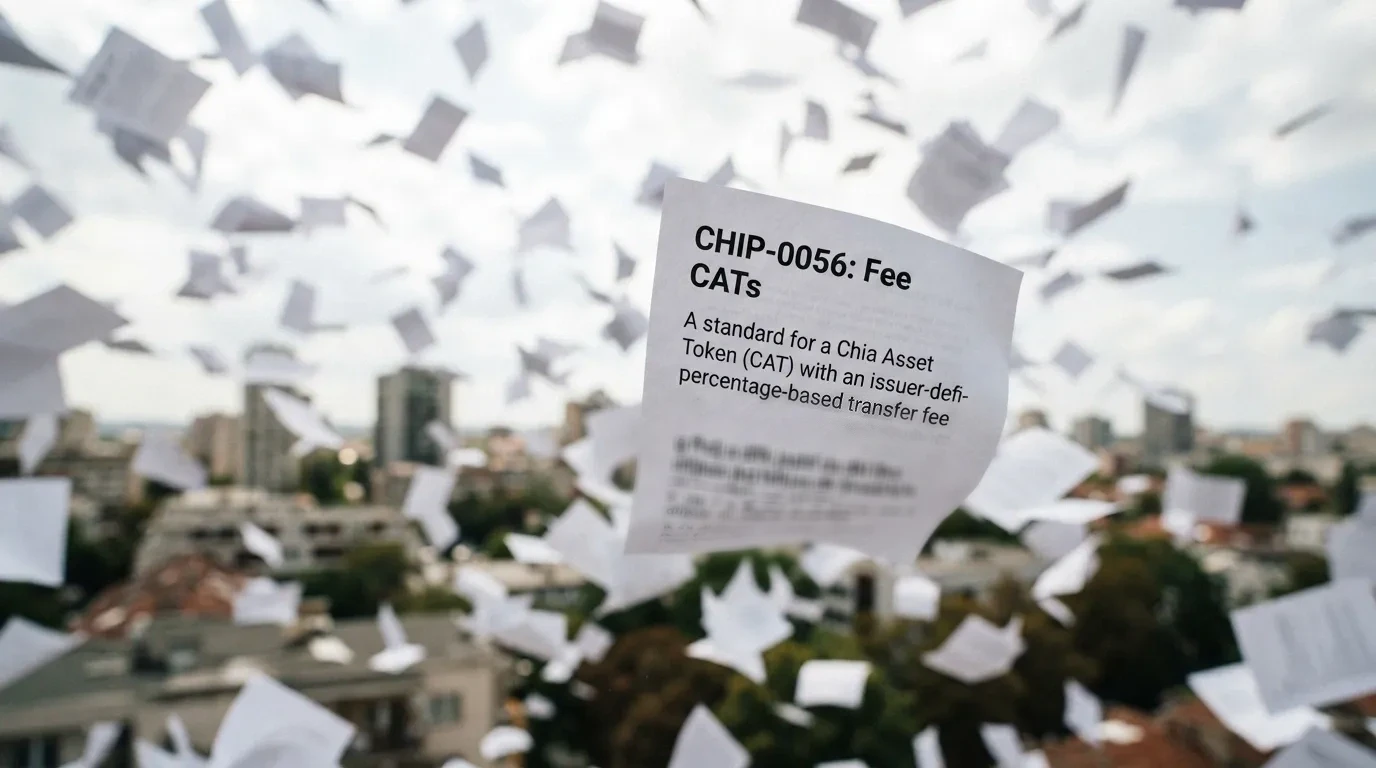
CHIP-0056 – Fee CATs
Enables: tokens that pay their issuer a cut of every trade.
Think NFT royalties, but enforced and for fungible tokens (CATs). The fee percentage is baked in at issuance and collected automatically on every offer trade, which gives token projects a sustainable revenue model and gives tokenized securities a way to handle transfer levies programmatically. Proposed by Cameron Cooper, currently in Review.
CHIP-0057 – Silent Payments
Enables: one public address, private payments.
Today, if you post an XCH address for donations, anyone can see every payment you receive. Silent Payments let senders derive a fresh, unlinkable address from your static one, so you publish one address but payments stay private. Adapted from Bitcoin’s BIP-352 for Chia’s cryptography. The tradeoff is your wallet has to scan the chain to find incoming payments.
CHIP-0058 – Parallel Voting at Scale
Enables: real on-chain governance. Around 20,000 voters per election, no trusted middleman.
Naive on-chain voting pushes every vote through a single tally coin, roughly one vote per block, so 20,000 votes could take 20,000 blocks. The usual fix is letting one operator count votes off-chain, which reintroduces trust. Michael Taylor’s design gets you both scale and trustlessness: votes happen in parallel on separate coins, and a ZK proof (verifiable by today’s CLVM, no fork needed) makes the final count impossible to fake. This points toward DAO governance actually working on Chia.
CHIP-0059 – Pooling Protocol v2
Enables: a cleaner pooling protocol, including finally being able to transfer plot NFTs.
Since everyone is replotting for PoS2 anyway, this is a unique opportunity to modernize pooling with minimal pain proposed by Matt Hauff. The original pooling code was impressive for its time but built under deadline pressure, as Bram Cohen admitted in the PoS2 Q&A. The rewrite fixes long-standing annoyances like plot NFTs being stuck in wallets, and lets pools transfer ownership or defer payments. Note that pool memberships won’t carry over to PoS2, and some pools have said they won’t make the jump at all.
CHIP-0060 – Titled CAT Standard
Enables: tokens that carry their own name, ticker, and supply rules, no registry needed.
Today a CAT’s name and image live off-chain in whatever list your wallet happens to use. A Titled CAT from Evan Winget (CNI) bakes that record into the token itself at mint time, along with supply commitments and optional creator identity, royalties, and revocability. It complements CATalog rather than competing with it: CATalog catalogs existing tokens, Titled CATs would let new tokens define themselves going forward.
CHIP-0061 – Remote Compact VDF Proofs
Enables: faster node syncing and smaller databases.
Chia blocks carry bulky timelord proofs, and Bluebox Timelords quietly recompute them into compact versions. Getting those compact proofs onto your node currently relies on chatty peer-to-peer gossip (as seen in the latency in propagating WesoForge work). Bill Blanke proposes letting nodes simply download pre-compacted proofs as files during sync. No consensus changes, and validation still catches any bad data, so there’s nothing to trust.
Looking ahead
The #chips channel in Discord and the GitHub PR threads are where the conversations happen.
We got fifteen CHIPs in fifteen months, spanning physical NFTs, a new proof of space, a dApp framework, dividend infrastructure, private payments, governance, pooling, and token standards could provide a glimpse as to what types of projects CNI and community developers are working on.
I suspect that behind each of these CHIPs are motivating use-cases which I expect we’ll hear more about in coming months.