
The information provided in this article is for informational purposes only and should not be considered as investment or financial advice.
With XCH consistently trading under $2 for the past month, does it still make sense to be farming Chia in 2026?
As always, the answer is “it depends” but the population of farmers for which it makes sense to continue farming has gotten smaller. In general, I’d say the same advice from day 1 still applies: farm with what you have and do it efficiently. If you find yourself looking at new retail drives, enterprise server hardware, uninterrupted power backups, and active cooling, then it’ll be tough to justify those overhead costs.
Price is down, but so is netspace
Farming yield is a function of price and netspace. Netspace has come down along with the price: netspace now sits under 4 EiBe and raw netspace is likely under 3 EiB, a long way down from the days of 30+ EiBe. While a high netspace is obviously more desirable for securing the network, a low netspace does mean more earned XCH for each farmer. As of writing, the monthly earning per 100TB is $4.8 USD, down from ~$9 USD a year ago.
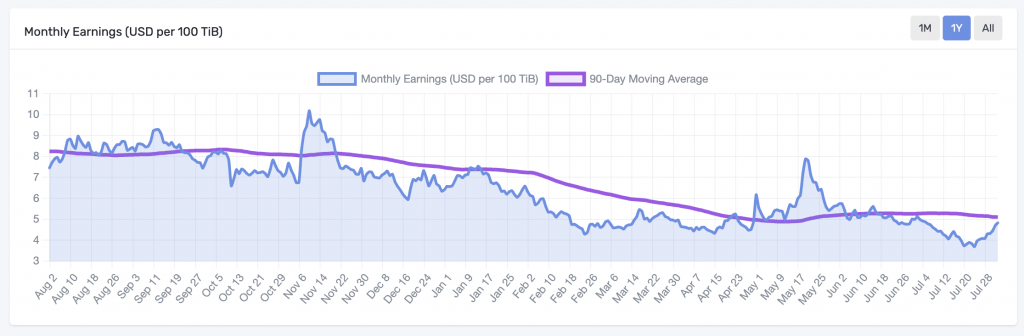
Though farming yield in dollar terms is down almost 50% from last year, if your ongoing cost of farming is just electricity for hardware that you would be running 24/7 anyway, then it could make sense to continue farming “OG plots” without overhead of GPUs. Especially compared to a PoW mining rig, the mostly idle load of Chia farming still allows casual home farmers to participate.
Plug your farm size and electricity rate into the XCH.farm profitability calculator and you’ll see your break-even ignoring hardware depreciation, which is the right way to model it if the drives are already paid for and running anyway, and whether you clear that bar comes down almost entirely to your electricity rate. For myself, I’m technically still profitable due to low rates in my area (less than 3c /kWh overnight) but I imagine the math just doesn’t make sense for most farmers.
At the end of the day, the network still has multiple raw exabytes behind it, which is significantly more than other storage-related cryptos:
- Chia: ~2,662 PiB (source)
- Filecoin: 1,997 PiB (source)
- Storj: 55 PiB (source)
- Signum: 30.2 PiB (source)
- Arweave: 20.9 PiB (source)
So who is still farming? I think there are two main groups. The first is anyone with genuinely low costs, meaning spare capacity that’s already spinning, power that’s already being paid for, or living in areas with low electricity rates or an existing solar setup. The second is the speculative farmer, someone who understands the math doesn’t work out at today’s price but is farming to accumulate XCH they believe will be worth more later, which amounts to dollar-cost-averaging into the coin through a power bill while also supporting the network security.
Farming hardware is valuable
If you were farming Chia at mainnet launch, you would remember the industry-wide impact it had on hard drives prices. And if you followed along the evolution of plotting and farming with GPU/RAM plotting and compressed plots, you may have acquired a bunch of RAM, SSDs, and GPUs despite the constant advice of “farm with what you have”.
As a result of the AI buildout that absorbed a lot of storage/GPU/RAM supply, hardware prices have spiked over the past couple years. I know of many farmers (myself included) that find themselves sitting on hardware that can be worth more now than 4-5 years ago.
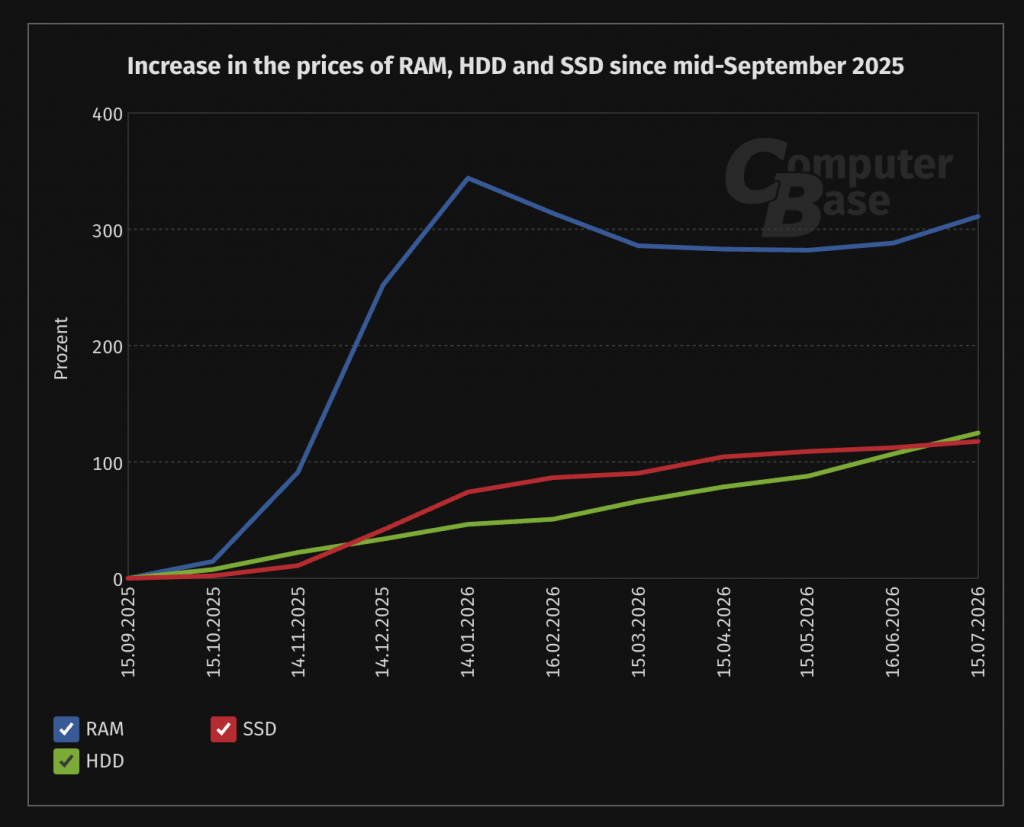
- Storage prices have roughly doubled. ComputerBase has tracked storage prices monthly since the shortage began, and their June 2026 check shows SSDs and HDDs at more than twice their September 2025 prices, with WD and Seagate sold out through 2026 on hyperscaler contracts. Their full price-tracking article also show RAM prices up 300% in the same time frame.
- GPUs are climbing too. TechSpot’s Q1 2026 pricing analysis found the RTX 50 series up 19% globally in just three months. Tom’s Hardware runs a live GPU price tracker if you want current street prices.
So what does this mean for existing Chia farmers?
The point of using commodity hardware is that there is resale value
The original idea of Proof of Space and Time was that a blockchain could be secured with commodity hardware that not only anyone has easy access to, but can always repurpose for other uses.
Chia farming is about the gentlest life a hard drive can have: a WORM (Write Once Read Many) workload where you plot the drive once and it then sits there serving tiny reads in read-only mode, so a drive with four years of Chia farming on it is in far better shape than one that spent years in a busy NAS, and the SMART data often proves it to potential buyers.
Personally, I’ve sold about 15% of my farm capacity this year through local marketplaces. In particular, the lower-capacity drives (8-10 TB) have been most popular, and they’re selling for more than I originally paid for them even with 4+ years of power-on hours. For many farmers, this boon could help put them at break-even or even slightly ahead despite declining XCH price.
The GPUs I’d accumulated from the compression era aren’t being sold though. I’ve repurposed them for local AI but the option to resell them (especially highly in-demand models like RTX 3090/4090s) is always there.
The fact that a resale market for farming hardware exists at all, let alone one paying above original purchase price, is precisely the point Chia’s founding design choice to secure the network with commodity hardware. An ASIC from a proof-of-work coin has exactly one use, and its resale value tracks only the mining economics, whereas a hard drive is useful to everyone, which is how Chia farmers can find themselves benefitting from an AI boom that has little to do with crypto.
New farmer? I’d say wait
If you’re thinking about starting a farm today, there’s really only one good reason, and that’s learning. There’s value in figuring out your hardware setup before much of the network replots but just make sure you’re not spending money to do it.
For anything beyond curiosity/learning, I’d suggest waiting a few more months. The PoS2 hard fork lands around November 2026 with everything plotted before it expiring after a 256-day transition. The new format is designed to make getting into farming easier and cheaper with ~1.8 GB plots + plot grouping, plotting on a Raspberry Pi 5 CPU, and no GPU needed for harvesting. Waiting a few months will get you a lower barrier to entry and skips a throwaway replot.
Where this leaves farming in 2026
Farming with what you have still works, and works a bit better than the price chart suggests thanks to the lower netspace, but really only if your costs are near zero.
Buying hardware to farm doesn’t make sense, now more than ever due to current hardware prices and low coin price, and PoS2 is about to lower the entry bar anyway. Meanwhile, existing farmers are holding hardware that has maintained resale value and everyone should consider if selling that hardware makes sense for them, which is the commodity-hardware thesis paying off as designed.
A blockchain network cannot be indefinitely sustained through collective altruism, it needs the economic incentives to make sense and that requires every farmer to make a logical decision for own situation — as Bram has tried to articulate in the past.
Personally, I’ll continue to sell hardware locally but will still be keeping a farm to replot to the new plot format. The latest iteration of the new plot format which was recently finalized manages to hit all the requirements to be farmer-friendly while staying secure. It promises to bring us back to an era of “farm with what you have” with even lower energy use than original “OG” plots. I’ll be doing a deeper dive on this plot format soon.