


XCHandles is launching on mainnet. Yakuhito announced that the decentralized handle protocol will deploy on August 20, 2026 at 09:00 UTC, with the launch site at xchandles.com. I’ve been expecting at least a couple of community dApps to launch this year, and XCHandles is the one will likely get the most use the most direct effect on everyday users, since it replaces a 60-character address with something like @yak.
What is XCHandles?
XCHandles is a decentralized address book. You register a handle such as @yak, and it resolves to an XCH address, display name, profile picture, and whatever else you put in the associated metadata. The documentation calls it the Chia equivalent of the Ethereum Name Service, and the spec lives in CHIP-0054.
Those of you that have been around a while will know that Chia already has Chia Name Service (CNS) and NamesDAO, but as CHIP-0054 puts it, those keep most of the logic off-chain, including the checks that stop two people ending up with the same name. Guaranteeing that a handle has exactly one owner on the blockchain itself and cannot be quietly reassigned is the hard part, and Yakuhito wrote about why on the FireAcademy blog almost two years ago.
Details worth knowing about XCHandles:
- Handles use an @ prefix, not a .xch suffix, chosen to avoid confusion and is unlikely to be mistaken for an address.
- Valid handles are 3 to 63 characters, lowercase a-z and digits only. No underscores or dashes.
- Registrations are priced in wUSDC.b, not XCH, because XCH’s dollar price is too volatile for long-term pricing.
- Registration process protects against sniping. Registering happens in two steps, with your choice of handle hidden during the first step and settled later in a future block so nobody watching the mempool can see what you’re claiming and try to snipe it from you.
Pricing follows the length-based model ENS uses, since shorter handles are assumed to be more desirable. Handles containing a digit cost half the price.
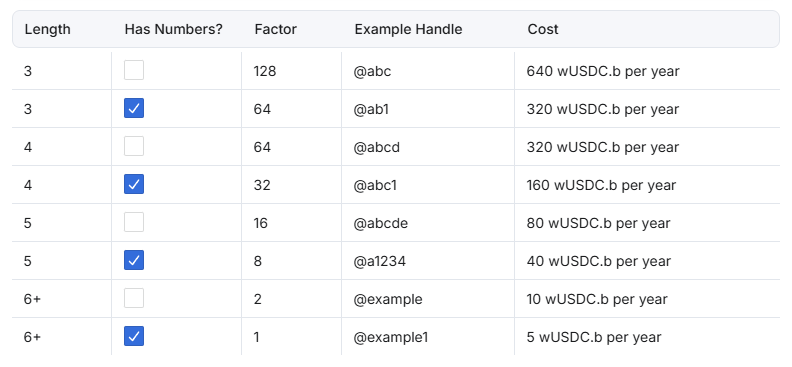
Prices aren’t fixed forever. A 6-of-10 multisig controlled by warp.green validators will control pricing but are limited to changing the cost of registration and expiry pricing. They cannot override, reassign, or take back a handle already held.
When a handle expires, a 28-day reverse auction starts, opening at an absurdly high price and halving every 24 hours until the premium reaches zero and anyone can register it at the ordinary rate. Someone trying to snipe an expired handle has to pay a steep premium to act early, and the original owner can wait them out.
How the launch is structured
The launch plan attempts to solve two problems: recognizing owners of names on existing name services and to prevent sniping/hoarding at launch.
The genesis allocation
Rather than opening registration to a blank slate, XCHandles reserves handles for people already holding matching names on CNS or NamesDAO, on the reasoning that recognizing existing claims is more fair than ignoring them. The full rules matter if you hold a legacy name, but at a high level:
- A snapshot of existing name holders was taken July 20, 2026 at 09:00 UTC.
- A legacy name qualifies if, after stripping .xch and dashes/underscores, it is a valid handle.
- CNS resolves first, with NamesDAO filling only what CNS didn’t claim. Exact spellings beat stripped ones, active beats expired, earlier registrations break ties. NamesDAO names beginning with underscores are excluded
- Handles allocated at genesis expire at 122 days, after which it can be extended by the owner at the standard price.
The published premine.csv currently holds 3,802 reserved handles going to 2,582 distinct addresses. This list is auditable by rebuilding the list using on-chain data.
Roughly 82% of this genesis allocation will expire in 122 days (December 20, 2026).
The opening reverse auction
Every unreserved handle (those not in the published list) goes through a two-week declining auction. Registration prices are multiplied by a global factor stepping down daily from 1000x on day one to 2x on day fourteen, settling at 1x on day fifteen. Normal length-based pricing still applies underneath, so these multiply: a 6+ character handle at 10 wUSDC.b per year costs 10,000 on day one and 20 on day fourteen.
The design borrows from how new DNS top-level domains launched, and the intent is that a contested handle goes to whoever values it most rather than whoever scripts the fastest claim at a flat low price. For most people the sensible read is that there’s no rush. Waiting until day fifteen costs 10 wUSDC.b and carries little risk, because anyone taking it earlier has to want it enough to pay a multiple. And there’s more available than you might assume: of the 46,656 possible three-character handles, the current premine reserves just four.
What to do before the August 20 Launch
If you hold a CNS or NamesDAO name, check on XCHandles to confirm both the recipient address and expiration are what you expect. The snapshot has closed, so you can’t change your position, but you can catch an error while the list is preliminary. Watch the recipient field especially, since it’s whoever owned the NFT at the cutoff, not a forwarding address set in metadata. Flag problems publicly before August 3.
If you’ve contributed to the Chia ecosystem, message @yakuhito on X before August 3, 2026 at 09:00 UTC with your XCH receive address, requested handle, and a short description of your contributions. Contributor handles expire August 20, 2027.
If you hold neither and want a handle, the work is getting wUSDC.b ready, since it’s the only accepted payment asset and it’s bridged from USDC on Base via warp.green. Then decide whether your handle is likely to be contested. If it isn’t, I’d suggest waiting until closer to day fifteen.
What this means for Chia
The name collision problem between CNS and NamesDAO has been unresolved since 2023, when both issued .xch names and wallets had to decide which to recognize. XCHandles doesn’t adjudicate that dispute nor directly replace either name service outright as that’s up to the community/market to decide which service they find most useful.
Whether XCHandles finds adoption depends on wallet integration and community support more than anything in the protocol, since a handle that only resolves on one site is a curiosity rather than a decentralized address book.
The other thing worth noting is what this launch demonstrates about building on Chia. XCHandles produced new primitives along the way, plus improvements to the chia-wallet-sdk and the Rue compiler, with the rewards distributor built in parallel with DIG. Those benefit everything built afterward, which is generally how it goes when Yak insists on solving the hard decentralized version of a problem.