
Why Chia 3.0’s PoS2 is Secretly a Rebellion Against Compression Greed
This content was contributed and posted on XCH.today with permission from its creator(s). All opinions and views expressed in the content belong to the content creator and are not necessarily shared by XCH.today. Opinions should not be interpreted as financial advice.
In the dim glow of a basement server rack, a farmer watches his dashboard. For years, compressed plots squeezed every last proof out of his drives. Then came the February 27, 2026 announcement from Chia Network. Chia 3.0 and the new Proof of Space 2 (PoS2) consensus were inbound. The message was clear: compression as we knew it was done. One GiB would equal one vote again.
This wasn’t just another upgrade. It was a deliberate reset–a rebellion against the “compression greed” that had quietly tilted the playing field. Big operators with specialized hardware and GPU farms gained an edge through time-space tradeoffs. Honest storage felt less honest. PoS2 flips the script. It returns Chia to its roots while preparing the network for the next decade. If you farm, plot, or just hold XCH, this change will reshape your setup. Here’s why it’s happening, what it means, and how to ride the wave.
The Original Dream: Space as Security
Chia launched with a radical idea. Instead of burning electricity like Bitcoin (Proof of Work) or staking tokens like many others (Proof of Stake), it used Proof of Space and Time (PoST). Farmers allocate hard drive space by creating “plots”–pre-computed collections of proofs. The more space you dedicate, the higher your chance of winning blocks and rewards. It was green, accessible, and decentralized by design. A spare hard drive in your garage could contribute meaningfully.
Early plots were straightforward k32s (roughly 100 GiB uncompressed). You plotted once, farmed forever (or until hardware failed). The system rewarded raw storage capacity. No fancy GPUs required. Bram Cohen and the team built it this way on purpose: security should come from physical resources anyone could provide, not compute power concentrated in data centers. For a while, it worked beautifully. Netspace grew, energy use stayed minimal, and the community embraced the “plant and forget” ethos. But crypto is never static. In 2023, plot compression arrived.
Compression Creeps In: The Rise of the Time-Space Tradeoff
Tools from projects like NoSSD and optimizations in Bladebit let farmers create smaller plots–15-30% space savings–by discarding data and recomputing it on the fly during challenges. It was a classic time-space tradeoff. Your plots took up less room on disk, but harvesting demanded more CPU or GPU cycles.
At first, it felt like a win. Small farmers stretched their hardware further. But the incentives quickly warped. Larger operations or those with powerful GPUs could run highly compressed setups profitably. Energy consumption during farming rose. “Phantom” netspace inflated apparent capacity–plots that represented less real storage. The playing field tilted toward specialists, and the Nakamoto Coefficient (a measure of decentralization) took a hit. Rental attacks became more plausible: someone could temporarily rent compute to simulate massive space.
Community forums lit up with debate. Some celebrated the efficiency. Others mourned the original vision. “A TB should be a TB,” as one Chia voice put it–not 1.5 TB if you throw GPUs at it. Compression wasn’t evil, but it introduced greed dynamics the protocol wasn’t built for. Plots became less about storing proofs and more about optimizing recompute tricks. The network’s security budget–tied to real, committed space–felt diluted.
By 2025-2026, it was clear something had to give. Chia Network had been working on a new plot format since at least 2024. The goal: make compression economically non-viable while keeping the system simple and green.
PoS2 Arrives: The Technical Rebellion
Chia 3.0 delivers Proof of Space 2 (PoS2). The headline is simple: no more viable compression. The new format uses a single-table design–a continuous blob of sorted cryptographic data with no structural redundancies that compression tools love to exploit. In theory, you could drop a few bits (maybe 2-3% savings), but reconstructing them in real time during a challenge requires orders of magnitude more compute. It’s simply not worth it. The economic incentive for compression dies.
Plots standardize on k28–roughly 1 GiB each. No more choosing k-sizes. “One GiB will equal one vote” becomes literal again. This levels the field dramatically. A spare external drive contributes just as meaningfully as a rack of enterprise storage, adjusted for its actual capacity.
Other clever innovations make it future-proof:
- Plot Strength: A parameter controlling upfront compute. Higher strength means fewer disk accesses later (great for power-hungry HDDs). Minimum strength starts low; the team doesn’t plan to raise it until at least 2036. Stronger plots don’t win more or less–they just trade plotting time for reduced runtime I/O. Each strength level roughly doubles creation effort after early overhead.
- Plot Groups and Meta-Groups: Up to 65,536 plots (65 TiB) can act as one logical unit. They pass filters together, enabling smarter disk management and just-in-time spin-ups. Meta-groups prevent too many simultaneous accesses on the same drive. HDDs can sleep more and wake briefly (~40-second window) when needed.
- Base Filter Reductions: The network starts with a base filter of 512 bits. It auto-decreases over years (to 256 in 2032, 128 in 2035, etc.). This extends plot longevity without forcing constant replots. Minimum-strength PoS2 plots should remain valid for at least a decade.
Harvesting stays lightweight. The new minimum spec is a Raspberry Pi 5 with 8 GB RAM, capable of farming ~2 PiB. Plotting benefits from GPUs (an RTX 5090 can do ~40 TiB/day at minimum strength) but CPU options exist too (a Ryzen 5600 manages ~4 TiB/day). All-RAM plotting is viable with modest VRAM.
The rebellion shines through in the details. By acquiring NoSSD technology around the same time, Chia Network removed a major vector for continued compression exploits on any potential minority chain. The design explicitly counters grinding attacks (exploiting consecutive filter passes) and prioritizes real committed space over clever shortcuts.
The Timeline: Months to Prepare, Not Panic
As of May 2026, the clock is ticking but there’s no immediate rush. Chia 3.0 (with PoS2 support) is expected soon after extensive testing. The hard fork activates at block 9,562,000–around November 2026. New PoS2 plots become fully eligible then.
Old plots don’t vanish overnight. A linear phase-out begins at the fork: they gradually produce fewer valid proofs (50% effectiveness halfway through). Full phase-out hits around block 10,741,648 (~June/July 2027). You’ll have ample time to replot at your own pace. Tools are promised to make gradual transitions easy–mix old and new plots during the window without big disruptions.
When should you replot? It depends on your hardware and electricity costs. Guidelines will help optimize. Many will wait until new plots are competitive or slightly advantageous. No need to panic-buy tomorrow. Wallet and node operators must upgrade to 3.0 before the fork (non-upgraded clients will desync, though funds stay safe). Cloud Wallet users just refresh the browser. Pool operators and ecosystem tools will need updates too.
Impacts on Farmers and the Broader Ecosystem
For everyday farmers, this is mostly good news long-term. Smaller, standardized plots make it easier to utilize fragmented spare drives. Reduced compression means lower farming energy bills for many. The playing field feels fairer–your garage farm competes on storage, not optimization hacks. Larger operations lose some “free” efficiency but gain predictability and lower attack surface. Netspace may dip temporarily as people replot, but honest capacity should stabilize higher. Security improves: real space backs the chain, boosting confidence for RWAs, carbon markets, gaming, and institutional use. There’s potential short-term chaos–forum debates, temporary reward fluctuations, maybe even fork drama (though the NoSSD move reduces that risk). Overall, it reinforces Chia’s “green and honest” brand at a time when other chains chase hype. Plot longevity is excellent. The base filter roadmap means today’s PoS2 plots could farm well into the 2030s. That’s commitment to farmers who hate frequent replots.
The Bigger Picture: Why This Rebellion Matters
Chia has always been the weird, principled chain–eco-friendly, compliance-focused, built by the BitTorrent guy who hates centralized power. PoS2 doubles down on that. It rejects the “move fast and optimize everything” mindset that turns blockchains into compute casinos. Instead, it says: commit real resources. Store the proofs. Let space do the work. In a world of AI-driven attacks, rental marketplaces, and energy scandals, this matters. A secure, decentralized base layer enables everything else–DataLayer for verifiable data, offers for peer-to-peer trading, CATs and NFTs without the usual headaches. When the plots are honest, the whole ecosystem gains trust.
It’s not flashy. No memes about lambos or moonshots. Just steady, thoughtful evolution. That’s the Chia way–and why it might outlast flashier competitors.
Time to Replot: Let’s Make the Reset Legendary
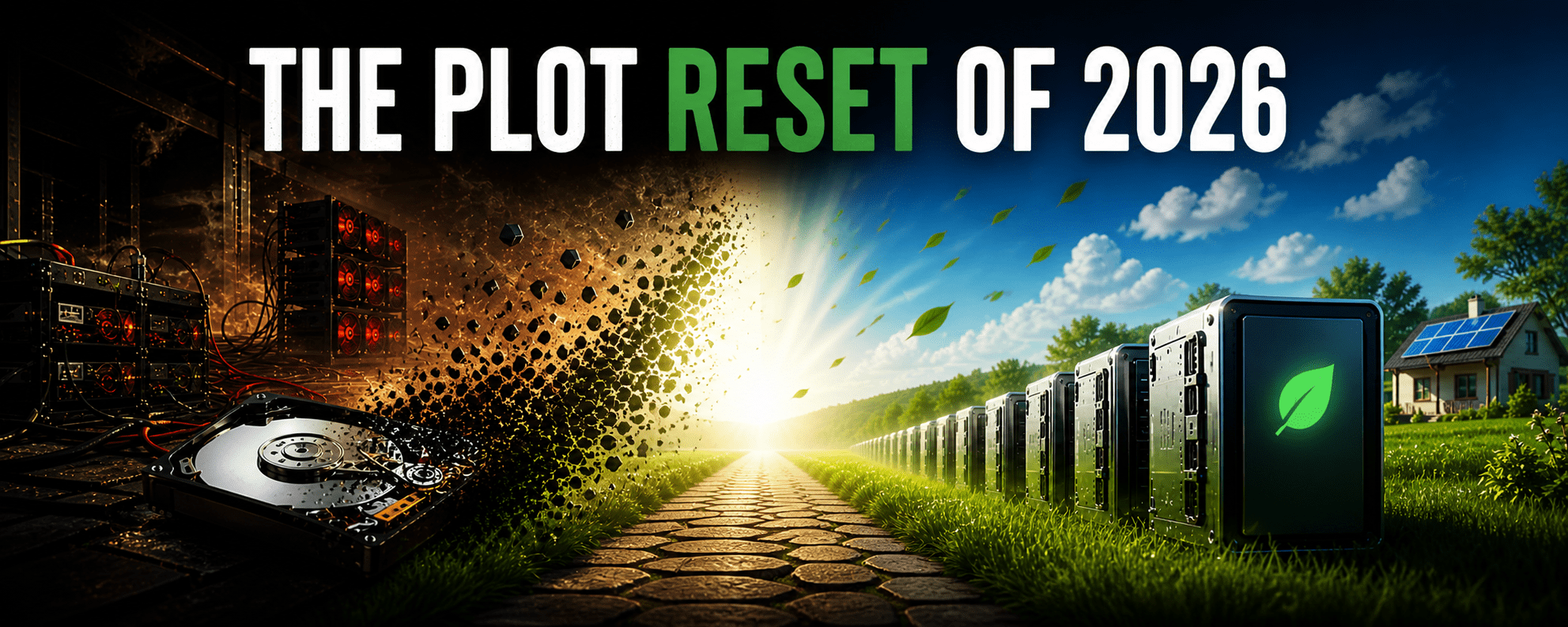
The Plot Reset of 2026 isn’t punishment. It’s correction. A return to first principles with smarter engineering for the long haul. Whether you run 10 TB or 100 PiB, now’s the time to plan. Start monitoring official channels for 3.0 release notes and replotting tools. Experiment with the reference implementation if you’re technical. Talk to your pool. Calculate the economics for your electricity rates and hardware.
Share your story in the comments or on forums–what’s your current farm size, and how are you approaching the reset? The community that grew this network from garage plots to real utility will make the transition smooth.
Chia’s roots run deep. With PoS2, they’re getting stronger. One gigabyte, one vote, one step closer to the sustainable future we were promised.