

The biggest change to Chia farming since mainnet launch is coming. Proof of Space 2.0 (PoS2) represents a fundamental shift in how plots work and will be the first mandatory replot for farmers. Find out what’s changing and what to expect going forward.
I’ve been following the discussions in the plot format discussion thread of the Chia Discord and the CHIP proposals (CHIP-0048, CHIP-0049) where Bram Cohen and Dr. Nick have been sharing updates. The PoS2 Reference Implementation is already public, so we can see exactly how things are coming along.
Note on terminology: Throughout this article, I use the term “compression” as it’s commonly understood in the community, even though technically these would be better called “unfinished plots”.
Why PoS2 Matters
When a new plot format was alluded to in an AMA in March 2024, I wrote a post explaining what it was attempting to solve and potential timelines. My estimate for when current plots would no longer be eligible to be farmed was 2.5–3 years. Almost two years since that post, it seems we are on the cusp of finalizing the plot format, with replotting expected to begin this year.
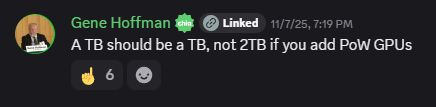
To summarize why PoS2 is important, it comes down to returning to Chia’s original vision of space securing the network, not compute. Gene put it succinctly in the Discord: “A TB should be a TB, not 2TB if you add PoW GPUs.”
And as a result of this new format and shift back towards storage, the hope is it will:
- Make the process of getting started farming simpler
- Reduce operational costs (energy use) of farming
- Recover Nakamoto Coefficient
- Increase security budget of the chain
What’s Changing
CHIP-48 published back in May 2025 has the technical details of the new plot format. Another update to this CHIP is expected soon based on discussions in the Discord. I’ll attempt to summarize the most important aspects of what the *final* plot format could look like:
- Only K28 plots: The new standard is k28 plots, which are about 1.8 GB each (much smaller than current k32 ~100 GB plots). These tiny plots allow farming on unused space and let farmers more efficiently fill larger drives.
The smaller plots can also be plotted quickly with less hardware, reducing concerns about SSD endurance. In fact, most desktop systems may be able to plot entirely in RAM, with or without a GPU to provide a speed boost. - Leveling the playing field: The new plot format is designed specifically to be as uncompressible as possible (see CHIP for technical details). Any energy spent on compression should not be offset by any marginal gains in simulated storage. The new format also uses AES that’s efficient on both CPUs and GPUs. This means CPUs won’t be severely outclassed by GPUs for plotting.
- Pi5 is the new baseline: The format is designed so that a Raspberry Pi5 can solve proofs using only its CPU. This keeps the barrier to entry low and allows for energy-efficient farm setups.
- Adjustable plot strength: Farmers can choose their plot strength at plotting time. Higher strength means longer plot times but lower disk load during farming. The resulting plot will be the same size and earn the same XCH either way – it’s just a tradeoff between upfront work and ongoing load.
Some benchmarks: With a 5090 GPU, plotting at minimum plot strength can reach ~30 TB/day with farming at an ongoing 10% disk load. Doubling the strength means plotting ~15 TB/day but farming at an ongoing 5% disk load. Choice of plot strength will be an interesting decision for farmers based on their individual setup. - Plot grouping: This idea was discussed more recently (and not part of the original CHIP), but it could greatly help with disk management. The idea is to bundle multiple plots that will pass the plot filter at the same time. This would let farmers explore tweaking disk idle states and minimize unnecessary spin-ups. The wake-up window would be around ~40 seconds–enough for HDDs but too short for tape. This also reduces the number of files on a drive. If this idea does make it into the CHIP, I expect to see creative farm setups centered around coordinated disk idling and just-in-time spin-ups.

What to Expect Next
Here are the upcoming milestones I’m looking forward to:
- CHIP-48 updated with final PoS2 design and features
- CHIP-49 updated with proposed hard fork and transition window timelines
- Chia 2.6.0 released with hard fork block heights committed
- Reference implementation gets updated with new PoS2 design with continued plotter optimizations over time
- Pooling protocol updated (e.g. plot grouping considerations)
- Chia 3.0 released with ability to farm new plots
- Transition period starts: new plots are eligible for farming
- Transition period ends: old plots no longer eligible for farming
With such a large change, I am also expecting a lot of communication (blog posts, X spaces, AMAs, Discord discussions) throughout the next 12 months to ensure a smooth transition to the new proof-of-space format.
Feb 3 2026 update: Chia Network Inc. announced a purchase agreement for NoSSD. Even without knowing the specifics of the agreement, I don’t expect this to impact the milestones above but rather, it will just reduce the likelihood of the new plot format progressing on a minority chain during the hard fork.